Most hosting control panels have become expensive bloatware. cPanel’s Solo license doubled to $30/month, Plesk jumped 26%, WHMCS raised prices 15%. Meanwhile DirectAdmin costs 1/3 the price with better performance, and free alternatives like HestiaCP work just as well.
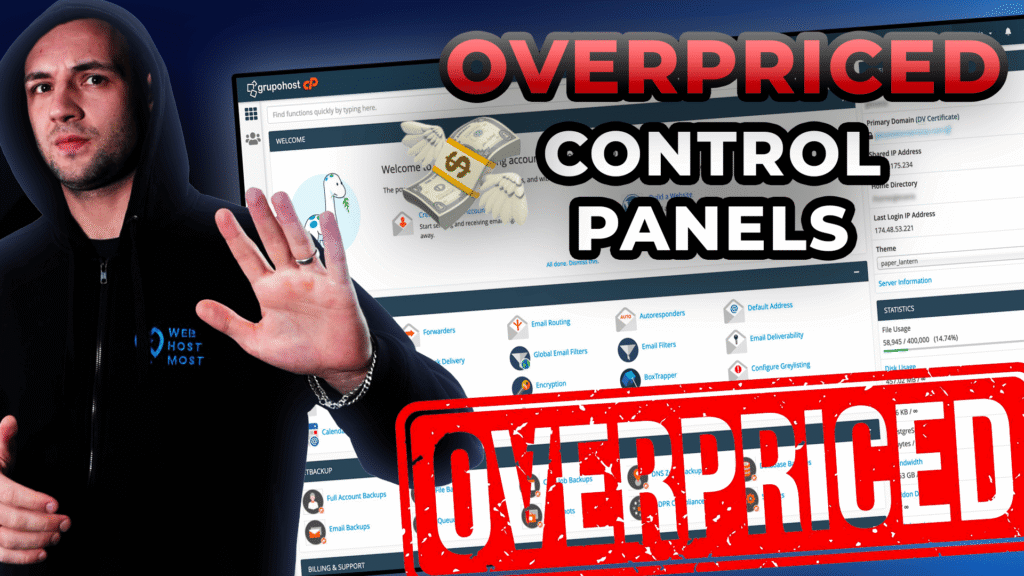
Control panels are supposed to make web hosting easier. Instead, most have become expensive, resource-hungry monsters that drain your wallet and slow down your server. If you’re paying $30-$70/month for a control panel license, you’re not investing in better hosting – you’re subsidizing corporate greed.
The control panel market in 2026 has turned into a textbook example of vendor lock-in exploitation. cPanel, Plesk, and WHMCS continue raising prices annually while adding features nobody asked for, creating bloated interfaces that consume more server resources than the websites they’re supposed to manage. The hosting industry has normalized paying more for panel licenses than actual server costs.
This isn’t sustainable. Smaller hosting providers get squeezed out, consumers pay higher prices, and server performance suffers. Meanwhile, lightweight alternatives like DirectAdmin and free open-source control panels prove that you don’t need bloatware to manage websites effectively.
cPanel’s 2019 pricing restructure marked the beginning of what the hosting community now calls “Black Week” – the annual announcement of yet another price increase. What started as a “one-time adjustment” has become a predictable yearly ritual.
Starting January 1, 2026, cPanel’s pricing structure looks like this:
The Solo license has nearly doubled in six years, climbing from $15/month to $29.99/month. Premier licenses jumped from $45 to $69.99. For hosting providers managing hundreds of accounts, the per-account overage fee means costs can spiral into thousands monthly.
According to industry reports, NOC partners face even steeper increases – 12% year-over-year for 2026. The Pro tier saw a brutal 17% jump, from $27.25 to $32 monthly.
Plesk announced a 26% price increase effective January 2026, with a structural shift from annual to monthly billing that eliminates any possibility of locking in rates. The Web Admin edition now starts around $16-18/month, while Web Host (unlimited domains) pushes past $50/month.
For context, that’s more expensive than the VPS server you’re running these panels on.
WHMCS completed the trifecta with a 15% price increase for 2026. Billing automation shouldn’t cost $2,000/month for unlimited clients, but that’s exactly what WebPros (the parent company behind cPanel, Plesk, and WHMCS) is charging.
The pattern is clear: WebPros has created a monopoly on “industry standard” tools and is systematically extracting maximum value from a captive market.
High licensing costs are only half the problem. Most commercial control panels have become resource-intensive applications that compete with your actual websites for server capacity.
cPanel runs dozens of background services that constantly consume CPU and RAM:
On a typical shared hosting server, cPanel itself can consume 500MB-1GB of RAM before a single website loads. That’s memory you’re paying for but not using productively.
Community discussions on LowEndTalk consistently mention cPanel’s heavy resource usage, with users reporting slower server response times and higher baseline CPU loads compared to lightweight alternatives.
cPanel justifies price increases by adding features like:
These sound impressive in marketing materials. In reality, most users need: file management, email accounts, database administration, SSL certificates, and DNS control. Everything else is bloat that increases complexity, slows down the interface, and provides more attack surface for security vulnerabilities.
The GetPageSpeed analysis correctly identifies cPanel as “bloatware” that tries to address every possible management need, resulting in unnecessary components running 24/7. It’s like installing Microsoft Office when all you need is Notepad.
The sticker price for control panels hides several additional costs that hosting providers and end users eventually pay:
Commercial control panels require more powerful servers than necessary:
A $5/month VPS becomes a $15/month VPS just to run the control panel smoothly.
cPanel’s recommended deployment includes CloudLinux ($15-25/month additional) for proper resource isolation in shared hosting. This turns a $70 Premier license into a $85-95 monthly expense.
Essential security and performance tools aren’t included:
Your “complete” control panel solution now costs $130-150/month before hosting a single website.
Bloated interfaces create support tickets. More features mean more confusion, more troubleshooting, and more billable hours explaining to clients how to find basic functions buried in nested menus.
cPanel’s market dominance lets it charge what economists call a “standard tax” – the premium you pay for being compatible with what everyone else uses. This isn’t inherently evil, but cPanel has weaponized familiarity into pricing power.
Switching costs are real:
These create switching friction that cPanel exploits annually with “minor” price adjustments that compound over time.
cPanel’s integration with Softaculous (one-click app installer) is frequently cited as a reason to stay. But consider: most installations are WordPress, which has its own easy setup. You’re paying $30/month for convenience on the 10% of sites that aren’t WordPress.
cPanel’s extensive documentation and training (cPanel University) creates dependency. New system administrators learn cPanel first, making them less likely to recommend alternatives even when those alternatives perform better.
Plesk positions itself as the “premium” alternative to cPanel, emphasizing its cross-platform support (Linux and Windows) and modern interface. The premium positioning justifies premium pricing.
Credit where due – Plesk does some things better:
But are these worth 26% price increases? For most users, no.
Plesk’s extension marketplace looks like added value until you realize core functionality should be included. Want proper email management? Extension. Need advanced security? Extension. Looking for site speed optimization? Extension.
Free extensions subsidize the base price, but paid extensions add up quickly. The result is unpredictable licensing costs that make budgeting difficult.
The bloatware problem extends beyond cPanel and Plesk. It’s an industry-wide pattern driven by misaligned incentives:
Control panel companies face a dilemma: how do you justify annual price increases? Adding features provides cover:
“We’re not raising prices arbitrarily – look at all these new capabilities!”
The problem is most users don’t want these capabilities. They want stable, fast, resource-efficient panels that do core hosting tasks well. But “we made it 10% faster” doesn’t justify a 10% price increase in marketing presentations.
Complex panels with proprietary structures create switching costs. The more features a panel has, the harder it is to migrate away. This is intentional design that prioritizes retention over user experience.
Modern control panels increasingly adopt SaaS business models: monthly/annual subscriptions with forced upgrades and no pricing certainty. This maximizes lifetime customer value for the vendor while creating budget uncertainty for providers.
Resource consumption by control panels directly impacts website performance. On shared hosting servers where dozens of sites share CPU and RAM, every megabyte the panel uses is one less megabyte available for customer websites.
Independent testing shows:
On a 2GB VPS, cPanel consumes 25-40% of available RAM before hosting begins. This forces providers to oversell less aggressively or invest in more powerful servers, costs ultimately passed to consumers.
Server resource contention from bloated control panels increases Time to First Byte (TTFB) for hosted websites. When the control panel and dozens of its background processes compete for CPU cycles, your website waits in queue.
Performance-focused hosting providers have noticed: switching from cPanel to DirectAdmin often improves average site TTFB by 15-25% without changing anything else.
DirectAdmin proves you don’t need bloatware for effective hosting management. It’s a commercial panel that costs 2-3x less than cPanel while consuming significantly fewer resources.
DirectAdmin’s licensing structure:
The Standard license costs less than cPanel Solo but supports unlimited accounts. For hosting providers, this is transformative: no per-account fees, no usage surprises, just predictable monthly costs.
DirectAdmin includes everything needed for professional hosting:
The interface is utilitarian, not pretty. But it’s fast, and every feature works reliably without consuming excessive resources.
WebHostMost runs DirectAdmin across our infrastructure. Average server load is consistently 30-40% lower than when we tested cPanel on identical hardware. This translates directly to better website performance for customers.
DirectAdmin’s lightweight design also means we can provision more accounts per server without degrading performance, savings we pass along through competitive pricing.
Honesty requires acknowledging weaknesses:
For hosting providers, these are manageable tradeoffs. For individual users new to hosting, the initial learning curve might be frustrating. But this is fixable with proper documentation – something WebHostMost provides.
The best price is $0. Several open-source control panels offer professional-grade functionality without licensing costs:
HestiaCP is a fork of VestaCP focused on clean design and modern features:
HestiaCP’s clean interface and low resource requirements make it ideal for individuals managing their own VPS or small hosting businesses. It lacks advanced reseller features but covers 90% of typical hosting needs.
Built on OpenLiteSpeed, CyberPanel emphasizes speed:
CyberPanel’s OpenLiteSpeed foundation delivers excellent WordPress performance without LiteSpeed licensing costs. The enterprise LiteSpeed version is available through partners for those needing additional performance.
Originally from Asia, aaPanel offers one-click installations and broad web server support:
aaPanel consumes more resources than HestiaCP but provides more flexibility. The plugin ecosystem supports Node.js, Python, Java applications beyond traditional PHP hosting.
ISPConfig targets multi-server hosting providers:
ISPConfig’s complexity matches its capabilities. It requires technical expertise but provides enterprise-level features without enterprise-level licensing costs.
Free panels require accepting different tradeoffs than commercial options:
For technically capable users or hosting providers with system administration expertise, these tradeoffs are negligible. For complete beginners, the lack of commercial support might be challenging.
At WebHostMost, we made a deliberate choice: DirectAdmin across all hosting infrastructure. This isn’t just cost optimization – it’s a philosophical commitment to efficiency.
We’ve been able to maintain competitive pricing specifically because DirectAdmin doesn’t force annual 10-15% price increases. When competitors raise prices to cover cPanel licensing, we don’t.
Our DirectAdmin infrastructure delivers consistently better performance than cPanel-based competitors:
This isn’t marketing spin – it’s measurable in server metrics and customer website performance.
We recognized DirectAdmin’s documentation weakness and addressed it: comprehensive knowledge base articles, video tutorials, and responsive support for DirectAdmin-specific questions. The learning curve exists, but we’ve smoothed it considerably.
We run DirectAdmin on CloudLinux for proper resource isolation without the cPanel tax. This combination provides enterprise-grade stability at a fraction of typical costs.
Switching control panels is intimidating. We offer free migration assistance from cPanel to DirectAdmin, handling the technical complexities so customers don’t have to worry about downtime or configuration errors.
Selecting a control panel should be based on actual needs, not industry defaults:
The hosting industry needs to stop normalizing annual price increases for stagnant products. Control panels are mature software that should be in maintenance mode, not perpetual “growth” phase justifying endless price escalation.
Hosting providers have power through collective action:
Customer resistance to change often comes from unfamiliarity. Most end users don’t care about the control panel – they care about managing their website easily. DirectAdmin, HestiaCP, and other alternatives do this just as well as cPanel.
Providers who switch need to invest in documentation and support to smooth the transition. The result is happier customers paying less for equivalent (or better) service.
Even if you stay with commercial panels, demand value for increasing prices:
Control panel vendors have gotten complacent because the market has let them. Competition creates better products at better prices.
Most control panels in 2026 are overpriced bloatware because the market structure allows it. WebPros owns cPanel, Plesk, and WHMCS – eliminating competitive pressure. They’ve systematically increased prices while adding unwanted features, creating resource-heavy panels that slow servers while emptying wallets.
This doesn’t have to be the industry standard.
DirectAdmin proves commercial panels can be lightweight, affordable, and feature-complete. Free alternatives like HestiaCP and CyberPanel demonstrate open-source solutions can match commercial functionality. The control panel monopoly persists because of inertia, not technical necessity.
WebHostMost chose DirectAdmin because it aligns with our values: provide reliable hosting efficiently, keep costs reasonable, invest in performance over unnecessary features. We’re not paying the cPanel tax, and neither should you.
The 2026 control panel landscape is broken, but alternatives exist. Whether you choose DirectAdmin for its commercial backing and efficiency, or open-source options for philosophical or budget reasons, you’re making a statement: control panels should enhance hosting, not dominate it.
Stop paying premium prices for bloatware. Your server – and your budget – will thank you.
Ready to experience faster hosting without the control panel tax? Explore WebHostMost’s DirectAdmin-powered hosting plans starting at competitive rates with transparent pricing and no surprise increases.
For more insights on hosting technology and cost optimization, check out our Blog for regular updates and comparisons.
